Last 15 September, Forbes House Madrid hosted “Fine Wine Strategy: How to Position Our Wines”, an event organised by EDA Drinks & Wine Campus – Basque Culinary Center and Círculo Fortuny, which brought together winery owners, Masters of Wine and industry professionals for almost five hours.
Fine Wine Strategy: How to Position Our Wines
The conversation went far beyond quality and highlighted some realities of the international market and the positioning of Spanish wines within the fine wine world:
A Spanish wine can be too cheap to be included in certain international fine wine selections.
At 67 Pall Mall, London, it is hard to sell a tasting of Spanish wines.
Although there is quality, our wines are still not the ones collectors are out looking for.
Three statements which, when put into context, help explain much of what was debated during the day.
Because the issue was not whether Spain is capable of making great wines. The debate was about everything that happens afterwards.
Quality, yes. But it is not enough
Joxe Mari Aizega, CEO of Basque Culinary Center, opened the day by setting out ten concepts: passion, origin, excellence, innovation, knowledge, talent, people… and brand.
One of his ideas anticipated much of the later conversation: quality is essential, but it is no longer enough.
Xandra Falcó, president of Círculo Fortuny, moved the debate into the territory of excellence brands. She spoke about knowledge, savoir-faire, talent, innovation, identity and values, but also about a brand’s ability to generate desire.
And here an especially interesting asset for Spain emerged: the experience.
Gastronomy, territory, culture, landscape, tourism, lifestyle and wine are all part of a proposition that is hard to separate when we talk about value and positioning.
He recalled that Spain has wines of proven quality, ageing potential, old vineyards and great professionals. However, its presence in the international spaces where prestige is built remains limited.
His point was particularly clear: we need brands.
And presence too.
Because an extremely limited production can create scarcity, but it raises another question: how do you make a wine known internationally if it can barely be found?
His phrase summed it up much better:
“With 2,000 bottles, we are not getting out of Aranjuez.”
He also raised another question that would come back during the day:
Who represents our wines outside Spain? Who speaks about them when we are not there?
Price, distribution and years of work
The winery owners’ panel made one thing very clear: there are no quick fixes.
Pablo Álvarez Mezquíriz, CEO Tempos Vega Sicilia, spoke about going to market, travelling, making mistakes, correcting them and carrying on working. Today the group exports to around 150 countries, but that positioning has been built over years.
And he delivered one of the day’s memorable lines:
“You have to put a beak on the dove and make it eat, not just draw the dove.”
In other words: the story can be excellent, but the wine has to move.
Guillermo Aranzábal, from Grupo La Rioja Alta, offered one of the clearest examples when talking about positioning.
Gran Reserva 904 has run into an unexpected problem in certain markets: being too cheap to be included in some price-based selections of great international wines.
That does not mean that raising prices automatically turns a wine into fine wine. In fact, the day also included warnings about excessive pricing.
The issue is different: price, distribution, perceived value and positioning all need to tell a coherent story.
Manu Muga, Bodegas Muga, added an essential point: thinking of distribution as an extension of the business, capable of taking a brand precisely to those channels that add image and reputation.
He also focused on sommeliers, their training and their ability to become ambassadors for our wines when they develop their careers outside Spain.
And she used London to show the scale of the challenge. As a member of 67 Pall Mall, she explained that Spain is present and can feature in tastings, but that selling the tickets remains difficult. In certain circles, Burgundy, Bordeaux or Italy still predominate.
So the issue is not only making a great wine. You have to make people interested in tasting it. Someone needs to put it on a list, recommend it, talk about it and make another consumer want to discover it.
This panel also brought one of the morning’s most interesting debates: how to build identity.
Willy Pérez, Bodegas Luis Pérez, put forward a different view: less centralisation and more diversity, freedom, individual projects and time.
And a deeper question hovered over much of the meeting:
to what extent should we keep looking to Burgundy as a model, and how much do we need to delve into our own territories, history and ways of understanding wine?
The secondary market: when quality is not enough either
The panel devoted to Liv-ex, auctions and the secondary market grounded many of those ideas.
Pablo Álvarez Esteban, director of Baghera Wines in Geneva, spoke from the other side of the table: the buyer and the collector.
His diagnosis was direct. There is quality, but there is still a lack of awareness and Spanish wine is not being sought out enough.
Moreover, a low price can mean a bottle is not interesting for an auction aimed at collectors, even if it could compete on quality.
And the issue of volume came up again: limited production is not necessarily incompatible with fine wine, but the market needs repetition, track record and scarcity that is understandable and predictable.
Collectors also do not want to go in blind. They look for information, traceability, track record and trust.
Ricardo Diéguez, from Herederos del Marqués de Riscal, explained the winery’s experience in La Place de Bordeaux and added a crucial nuance: not every winery needs to be there.
He spoke of patience, historical archives, documentation, price consistency and a long-term strategy.
And he pointed to one of the problems that has at times affected Spain: approaching these mechanisms as a one-off opportunity, rather than building a category consistently over years.
From Gramona, Jaume Vial returned to the same word: time. Time and discipline.
A brand cannot keep changing availability, prices or strategy without losing credibility.
And he raised a particularly interesting reflection: before asking how many Spanish brands can reach the secondary market, we should ask how many are truly global brands.
From the three contributions, much the same conclusion emerged: the secondary market should not be the starting point. First, a brand has to be built.
Communicating value without speaking only to experts
The final panel took the debate towards communication, marketing and the consumer.
Enrique Valero, from Abadía Retuerta, spoke about the brand as “a store of trust” and about the importance of being able to say no as well: deciding where a brand wants to be and where it does not.
Because distribution and communication are closely linked.
Paco Berciano, from the distributor Alma Vinos Únicos, focused on authenticity and the need to explain why a wine moves people, but he also questioned an overly complex language that can end up putting consumers off.
And Montse Alonso, from Mahala Wine, summed up another of the day’s ideas: price can position; communication builds meaning.
A bottle priced at 150 euros needs more than simply a different price from one at 15. It needs context, coherence, story, recommendation and a reason to be desired.
And, above all, we need to be able to tell that story not only to those who already know a great deal about wine, but also to those who want to discover and enjoy it.
Four fine wine candidates and conclusions
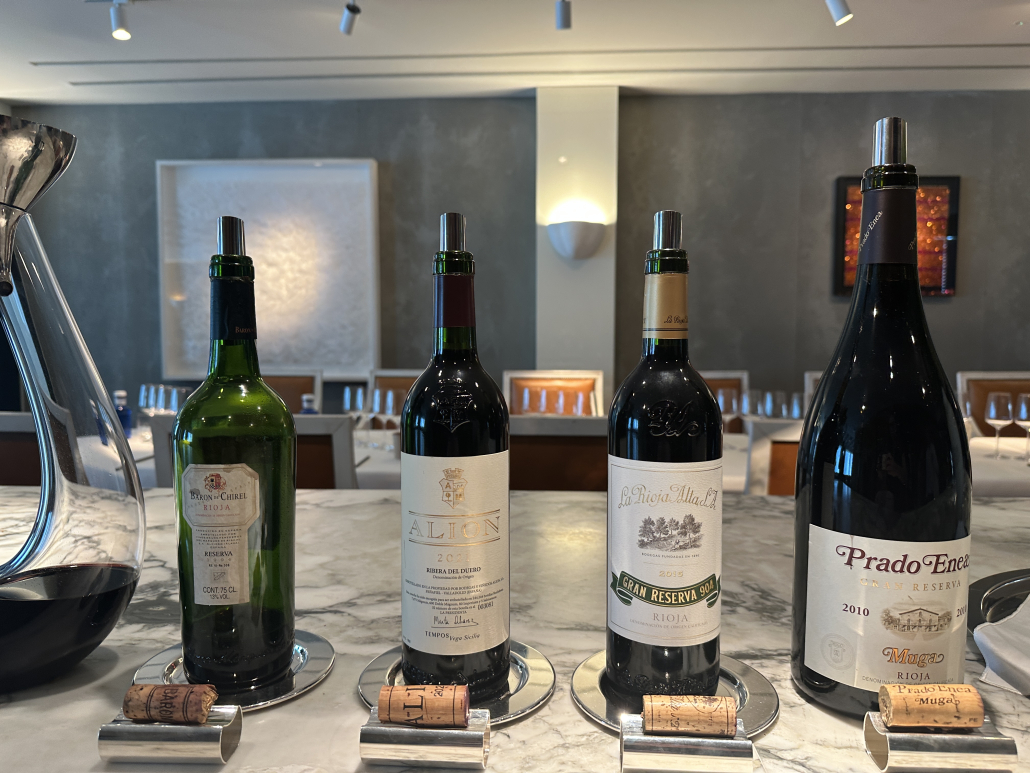
The finale was a tasting led by Pedro Ballesteros MW with four wines in contention, in his view, for a place in that universe:
Alión 2021 · Tempos Vega Sicilia La Rioja Alta Gran Reserva 904 2016 · Grupo La Rioja Alta Muga Prado Enea Gran Reserva 2010 · Bodegas Muga Barón de Chirel 1994 · Marqués de Riscal
Four very different wines after almost five hours talking about brand, distribution, identity, the secondary market, communication and time.
There was no single recipe. Nor a single definition of fine wine.
But there was a question hanging in the air: how can the quality that already exists in many Spanish wines also be translated into recognition, demand and international value?
Photos
.
Wine
Alión – La Rioja Alta Gran Reserva 904 – Muga Prado Enea – Barón de Chirel
Winery
Vega Sicilia – La Rioja Alta SA – Muga – Marqués de Riscal
Para ofrecer las mejores experiencias, utilizamos tecnologías como las cookies para almacenar y/o acceder a la información del dispositivo. El consentimiento de estas tecnologías nos permitirá procesar datos como el comportamiento de navegación o las identificaciones únicas en este sitio. No consentir o retirar el consentimiento, puede afectar negativamente a ciertas características y funciones.
Funcional
Always active
El almacenamiento o acceso técnico es estrictamente necesario para el propósito legítimo de permitir el uso de un servicio específico explícitamente solicitado por el abonado o usuario, o con el único propósito de llevar a cabo la transmisión de una comunicación a través de una red de comunicaciones electrónicas.
Preferencias
El almacenamiento o acceso técnico es necesario para la finalidad legítima de almacenar preferencias no solicitadas por el abonado o usuario.
Estadísticas
El almacenamiento o acceso técnico que es utilizado exclusivamente con fines estadísticos.El almacenamiento o acceso técnico que se utiliza exclusivamente con fines estadísticos anónimos. Sin un requerimiento, el cumplimiento voluntario por parte de tu Proveedor de servicios de Internet, o los registros adicionales de un tercero, la información almacenada o recuperada sólo para este propósito no se puede utilizar para identificarte.
Marketing
El almacenamiento o acceso técnico es necesario para crear perfiles de usuario para enviar publicidad, o para rastrear al usuario en una web o en varias web con fines de marketing similares.



 .


The conversation went far beyond quality and highlighted some realities of the international market and the positioning of Spanish wines within the fine wine world:
Three statements which, when put into context, help explain much of what was debated during the day.
Because the issue was not whether Spain is capable of making great wines. The debate was about everything that happens afterwards.